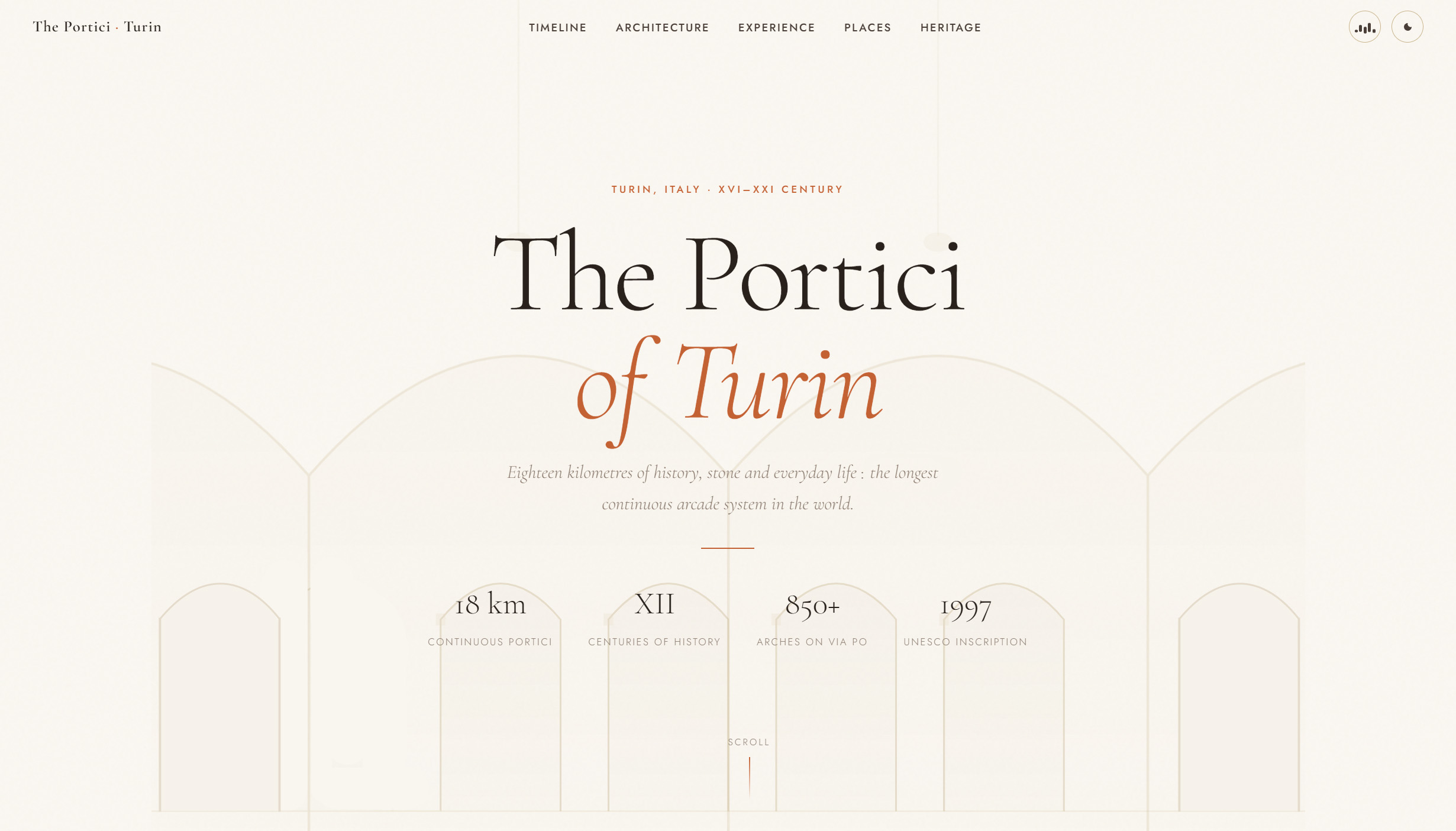
The Atlas of Strangerhoods brief asked for a map of how strangeness, belonging and material ecologies shape everyday life in Turin. Our answer was the Portici: kilometers of continuous covered arcades, among the longest in the world. We edcided to build a scroll-based web experience that moves through the arcades' construction periods and then turns to look at what lives there that nobody notices.
Who are Turin's strangers?
The brief asked for strangers: entities that exist in the city but don't belong to its official narrative. We spent time in the arcades: walked them, photographed them, read their history. Across the centuries they have been royal passages, markets, shelters, social spaces and thoroughfares. They are deeply public and deeply familiar.
Then the surfaces. The dark staining on the vaulted ceilings. The patches of texture on the stone columns. Organisms that have lived in the Portici for as long as the Portici have existed, invisible to the people passing under them every day. The strangers were always there. We only had to look up.
"The arcades are Turin's most public space. The fungi are its most persistent strangers: present for centuries, invisible almost by default."
Two layers, one city
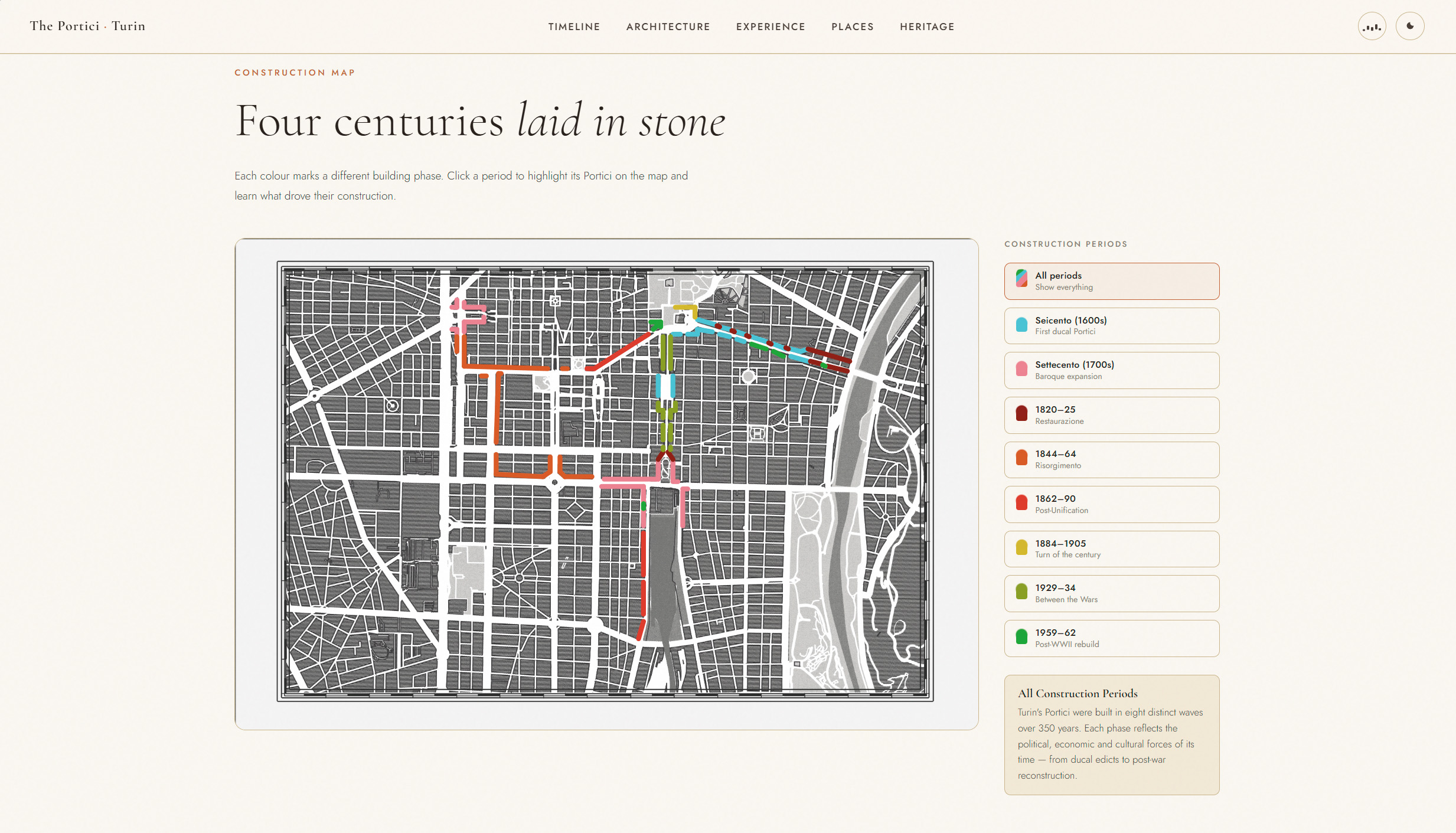
The experience works in two registers. The first is cartographic: an SVG map of Turin's arcade network, coded by construction period, with a toggle that lets people filter across eight historical periods and watch the covered walkways grow outward from the medieval center.
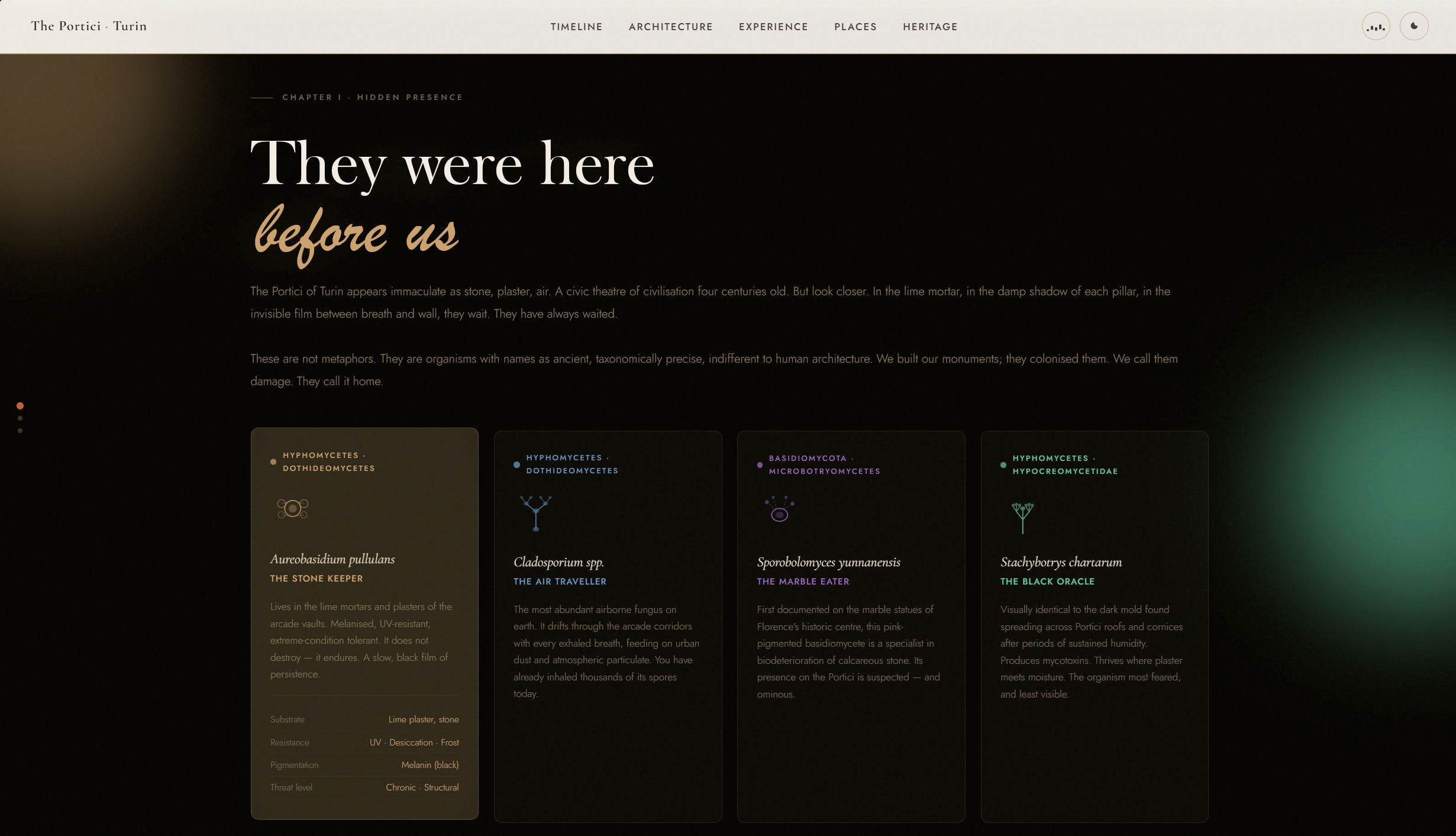
The second register is narrative: Monsters, Gods & Strangers, a scroll-driven chapter sequence of chapters about the organisms colonising the surfaces of the Portici. Aureobasidium pullulans, Cladosporium species, and others; Each chapter follows a lifecycle and asks what it means to belong to a place that has never acknowledged you
Fieldwork first, then code
The research came before any design. We walked the arcade routes, documented surfaces and cross-referenced historical maps of Turin's construction with archival sources. After that we inferred the most possible species present in the portici using fungi databases and comparing climate and other external conditions that allows certain types of fungi to be present in that structure. The SVG roads come from that fieldwork: hand-drawn paths traced against historical cartography, then coded into the interactive layer with period filtering.
Everything is vanilla HTML, CSS and JavaScript, with no framework. The scroll behavior, the SVG interactivity and the chapter animations are written from scratch, a deliberate choice because the site had to load fast and feel precise.
Completed as a multi-course project at IED Torino. It turns a mapping exercise into a question about visibility: what makes something a stranger is not where it comes from, but whether anyone is paying attention.